25 Best ChatGPT Prompts for Resume Writing in 2026
25 ChatGPT prompts to draft, tailor, and fact-check your resume, built on your real experience instead of invented achievements.


Key Takeaways
- The best ChatGPT prompts for resume writing start with your verified career notes and one target job description, then ask ChatGPT to question you about missing details before it drafts anything.
- The 25 prompts follow six stages: drafting from scratch (Prompts 1-4), summaries and objectives (5-7), bullet points (8-11), tailoring and ATS formatting (12-17), senior and complex careers (18-21), and proofreading and fact-checking (22-25).
- Strong resume bullets show your action, scope, and a supported result. Without a verified metric, describe workload or responsibility accurately rather than letting ChatGPT invent a percentage.
- Tailoring a resume changes emphasis, not history: titles, dates, and ownership stay identical across every version, and job-posting keywords belong only where your experience supports them.
- ChatGPT can flag common ATS parsing risks such as columns, tables, and contact details in headers, but it cannot simulate an employer's applicant tracking system or predict a screening score.
- Before submitting, compare every title, date, metric, and ownership claim in the final draft with your source notes, watching for strengthened verbs or new numbers added during editing.
Writing your own resume can feel uncomfortably close to judging your career. You are asked to describe your achievements, but some of your best work may have involved keeping customers happy, preventing mistakes, or making sure a project actually got finished. Explaining that contribution takes thought.
ChatGPT can help you work through it. A useful resume prompt asks for relevant details, connects them to the role, and improves the wording while preserving what happened.
Evidence suggests writing assistance matters. A 2025 study published in Management Science found that applicants receiving resume-writing assistance were hired 8% more often on an online labor platform. The experiment tested nongenerative editing assistance, so that figure should not be treated as a promise about ChatGPT.
This guide brings together 25 of the best ChatGPT prompts for resume writing, organized around the work you need to do: build a first draft, explain your achievements, tailor your experience, and review the result.
How to Get Useful Resume Results from ChatGPT
Start by helping ChatGPT understand your work before asking it to describe your value. A job title and a list of duties leave too much unexplained: what you handled independently, which problems you solved, and why your contribution mattered.
You do not need polished notes. You need enough detail to make those distinctions.
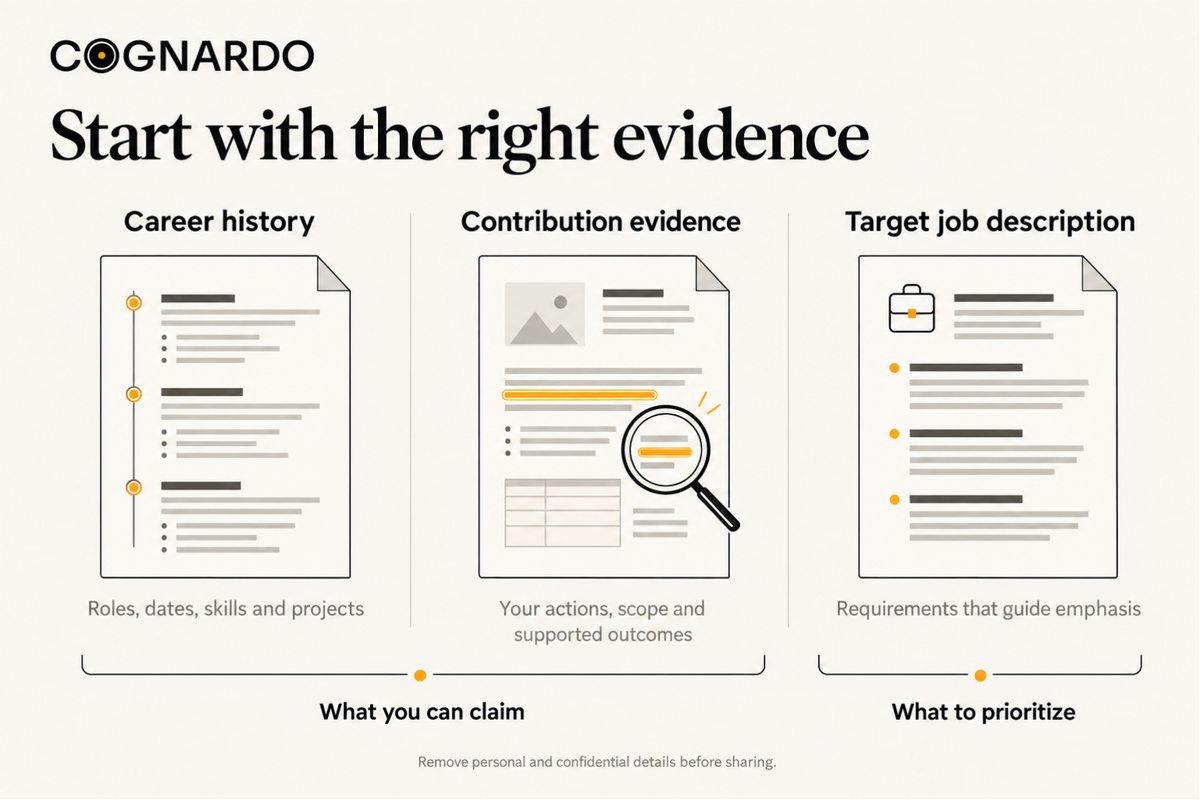
Gather Your Resume, Career Facts, and Target Job Description
Prepare three things:
- Your career history: Your current resume or notes covering roles, dates, education, skills, and relevant projects. For an entry-level application, include internships, coursework, and volunteering.
- Evidence of your contribution: Review project records, performance feedback, and work samples you are permitted to use. Look for responsibilities you took on, problems you resolved, and improvements you can substantiate.
- One target job description: Keep it separate from your career notes. Use it to decide which evidence deserves emphasis, while preserving your actual titles and qualifications.
If you struggle to identify achievements, start with the work people relied on you to do well. Did you resolve recurring customer questions? Catch errors before publication? Coordinate a difficult handoff? Record the specific action and its outcome.
Numbers help when they establish something meaningful. If you cannot verify an improvement percentage, describe the workload, complexity, or responsibility accurately. Avoid turning a team result into an individual claim.
Before sharing these materials, remove unnecessary personal details and confidential information. You can describe a project’s purpose without disclosing a client’s identity or private business data.
Set Rules for Facts, Missing Information, and Output
Use the same foundations covered in Cognardo’s guide to writing better AI prompts: relevant context, a defined task, and clear output requirements.
For resume work, make three instructions explicit:
- Ask about missing information before drafting. A focused question about your contribution is more useful than an invented achievement.
- Preserve the meaning of your experience. Keep titles, dates, qualifications, ownership, and results accurate.
- Explain substantive changes. Ask for the revision alongside a short note identifying anything removed, emphasized, or left unresolved.
Check the output against your original notes. Pay particular attention to verbs such as “led,” “owned,” and “increased,” which make specific claims about responsibility or results. Keep wording you can explain confidently in an interview, then review the finished document and the employer’s submission instructions.
ChatGPT Prompts to Write a Resume from Scratch
You can start with incomplete notes. The first task is to identify what is missing and recover the details worth including. Use Prompt 1 for that conversation, then choose the drafting prompt that fits your situation.
Replace each {{field}} with your information before sending. Keep unverified details clearly labeled.
Turn Career Notes into a First Draft
Use the first prompt when you can describe your responsibilities but struggle to explain your contribution. It asks questions before attempting a rewrite, giving you a chance to recover details that a general request might miss.
Prompt 1: Interview Me to Collect Missing Career Details

Help me prepare accurate source material for a resume targeting {{target_role}}.

Career notes:
{{career_facts}}

Job description:
{{job_description}}

Review my notes and interview me about missing information. Ask up to three focused questions at a time, then wait for my answers. Prioritize my personal contribution, scope of responsibility, relevant skills, and evidence of results.

If I cannot provide a metric, ask about observable outcomes or scope. Do not suggest invented achievements.

Finish with organized career notes for me to confirm, separating established facts from unresolved details.
Check what was omitted as well as what was included. Relevant experience can disappear when a draft is shortened.
Build an Entry-Level Resume with Limited Experience
Your evidence may come from work completed outside a paid role. Select projects, coursework, and activities relevant to the position, then explain what you actually did. A course title alone tells the reader less than a specific project completed within it.
Prompt 3: Build a Resume Around Relevant Early-Career Experience

Create an entry-level resume targeting {{target_role}}.

Education, projects, internships, employment, and volunteering:
{{career_facts}}

Job description:
{{job_description}}

Prioritize experiences that demonstrate relevant skills. For projects, describe the task, tools used, my contribution, and any supported result. Label academic, personal, volunteer, and paid work accurately.

Recommend a section order based on my strongest evidence. Exclude unrelated coursework and unsupported skill claims.

Ask about missing details before drafting any affected bullet. Do not invent experience or metrics.
Check that you could explain how you used every tool and skill listed. Completing a guided exercise and using a tool independently are different levels of experience.
Write a Career-Change Resume Around Transferable Skills
A career-change resume needs to make the connection understandable. For example, coordinating client deadlines may support a claim about project coordination. It does not automatically establish experience managing budgets or leading a project team.
Prompt 4: Connect Existing Experience to a New Role

Help me adapt my resume for a move from {{current_field}} into {{target_role}}.

Verified career history:
{{career_facts}}

Job description:
{{job_description}}

First map relevant requirements to specific evidence from my history. Separate supported transferable skills from requirements I have not demonstrated.

Then draft relevant experience bullets using terminology that accurately describes my work. Preserve actual titles, dates, seniority, and responsibility.

Keep employment history chronological. Do not rename previous roles or imply qualifications I lack.
Review the connections yourself. Similar wording does not always mean equivalent experience.
Once you have refined a useful prompt, save it in Cognardo Workbench with reusable fields for your career information and target role. Workbench asks you to fill those fields when inserting the prompt, so you can update the details for another application. See how Workbench saves and reuses prompts.
ChatGPT Prompts for Resume Summaries and Objectives
Write the opening statement after the main resume. You can then select the strongest evidence already on the page. A summary can bring relevant experience together; an objective can clarify a career direction that needs explanation. Include either one only when it helps the reader understand your application.
Write a Summary for Your Target Role
Use this ChatGPT resume summary prompt when your experience needs a concise introduction. Comparing two options helps you decide which strengths matter most for the role.
Prompt 5: Create an Evidence-Based Resume Summary

Write two resume-summary options of 35–50 words for {{target_role}}.

Verified resume:
{{resume_draft}}

Job description:
{{job_description}}

Select the most relevant supported experience, skills, and achievements.

Do not add credentials, metrics, seniority, or years of experience that the resume does not establish. Avoid generic personality claims.

Make each option emphasize a different supported strength.
Check that every claim has evidence elsewhere in the resume.
Improve a Generic or Overwritten Summary
Phrases such as “results-driven professional” take up space without identifying a result. Replace them with information that helps someone assess your suitability.
Prompt 6: Replace Vague Wording with Verified Strengths

Revise this summary for {{target_role}}.

Current summary:
{{current_summary}}

Verified career information:
{{career_facts}}

Job description:
{{job_description}}

Identify vague, repetitive, or unsupported claims.

Rewrite the summary in no more than 50 words using relevant evidence from my career information. Preserve factual meaning.

Explain significant changes and flag missing evidence rather than inventing replacements.
Read it without your name. Does it communicate anything specific about your experience?
Decide Whether an Objective Adds Useful Context
An objective should clarify the role you are pursuing and the relevant background you bring. General statements about seeking growth add little.
Prompt 7: Decide Whether to Include an Objective

Assess whether an objective would clarify this application.

Resume:
{{resume_draft}}

Target job:
{{job_description}}

Career direction:
{{career_goal}}

Recommend including or omitting it and explain why.

If useful, write one sentence of up to 30 words connecting my intended role with supported experience.

Do not invent qualifications or repeat an existing summary.
Keep it only if it explains something the rest of the resume leaves unclear.
ChatGPT Prompts to Improve Resume Bullet Points
A useful resume bullet helps an employer understand what you did, the responsibility involved, and what came of it. Some contributions have measurable results. Others demonstrate sound judgment, reliability, or the ability to handle complex work.
These ChatGPT prompts for resume bullet points help you find the strongest, most accurate description of that contribution.
Turn Duties into Specific Contributions
Start with responsibilities that reveal little about your work, such as “handled reporting” or “supported content production.” Give ChatGPT the details behind them before asking for a rewrite.
Prompt 8: Rewrite Responsibilities Using Action, Scope, and Supported Results

Rewrite these responsibilities as resume bullets for {{target_role}}.

Responsibilities:
{{current_bullets}}

Verified details about my work:
{{career_facts}}

Describe my action, relevant scope, and any supported result. Use only the supplied facts. If no outcome is established, describe the contribution without inventing an improvement.

Return each original bullet beside its revision. Flag any missing detail that would materially strengthen it.
Illustrative example
- Underlying facts: Briefed three freelance writers and reviewed 12 articles monthly for accuracy and brand voice. No traffic or revenue impact was measured.
- Before: Responsible for content production.
- After: Briefed three freelance writers and reviewed 12 articles per month for accuracy and brand voice.
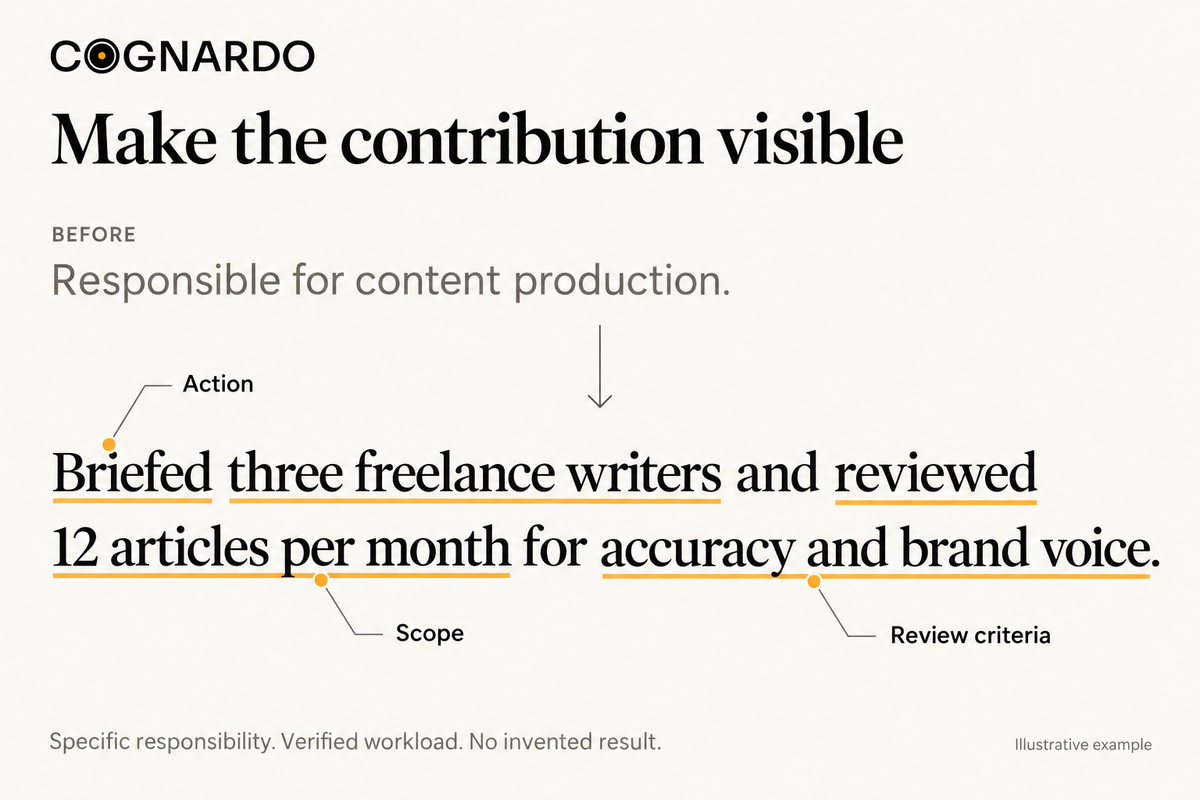
The revision establishes responsibility and workload without claiming an unmeasured business result.
Find Metrics You Can Actually Verify
A number needs a source and a clear meaning. Processing 40 requests each week describes workload; reducing turnaround time describes an improvement. Establish which claim your records support.
Prompt 9: Uncover Evidence for Measurable Results

Help me identify defensible metrics for these resume bullets.

Bullets and supporting notes:
{{career_facts}}

Ask up to three questions at a time about volume, frequency, time, quality, or outcomes. Wait for my answers.

For any proposed improvement metric, establish the baseline, comparison period, units, and supporting record. Show any calculation using only confirmed figures.

Do not estimate missing numbers. Where evidence is unavailable, suggest accurate qualitative wording.
Recalculate suggested percentages yourself. Cognardo’s free AI output verification checklist provides checks for numerical claims, assumptions, and unsupported conclusions that you can apply here.
Show Your Contribution to Team Results
You can discuss a successful team project while being precise about your part. Specify whether you led the work, owned a deliverable, or supported someone else’s execution.
Prompt 10: Separate Individual Responsibility from Team Outcomes

Rewrite this team achievement as an accurate resume bullet.

Team project and outcome:
{{team_result}}

My verified responsibilities:
{{my_contribution}}

Distinguish what I personally owned from the team's result. Choose verbs that match my responsibility. Include the team outcome only with clear attribution and a supported connection to my work.

Ask about unclear ownership before drafting. Do not imply that I independently caused the entire result.
Check whether the wording would give an interviewer the right understanding of your authority and contribution.
Make Bullets Clearer and More Concise
Edit for clarity after checking the substance. Cutting a few words is useful only if the reader can still understand the work.
Prompt 11: Tighten Wording Without Changing Meaning

Edit these resume bullets for clarity and concision.

Bullets:
{{current_bullets}}

Remove repetition, filler, and unnecessary introductory phrases. Use direct verbs that preserve the original level of ownership.

Retain relevant tools, scope, results, and qualifications. Do not add facts or force every bullet to the same length.

Return original and revised versions. Flag any cut that could remove meaningful evidence.
Reject a shorter version if it obscures what you actually did.
ChatGPT Prompts to Tailor Your Resume and Review ATS Formatting
Tailoring a resume means deciding which evidence matters most for a particular role, then making that evidence easy to find. Keep your career history consistent across applications while adjusting emphasis, detail, and relevant terminology.
Choose the prompts you need. Start with Prompt 12 if the fit is unclear, use 13 for skills, 14 for prioritization, or 15 for rewriting. Prompt 16 compares applications; Prompt 17 reviews formatting.
Match Job Requirements to Your Actual Experience
Read the requirements before adding keywords. Naming a tool you have used can clarify your fit. Adding a tool because it appears in the posting creates a claim you may have to defend.
Prompt 12: Map Job Requirements to Supporting Evidence

Compare this job description with my verified career information.

Job description:
{{job_description}}

Career information:
{{career_facts}}

Create a table showing:
- Requirement
- Required, preferred, or unclear priority
- Specific supporting evidence from my background
- Partial match, missing evidence, or question to resolve

Use the employer's stated priorities. Do not invent requirements or assume missing information means I lack the experience. Do not assign a compatibility score.
A simple evidence map can prevent an inaccurate rewrite:
Job requirement | Candidate’s evidence | Appropriate treatment |
|---|---|---|
Analyze campaign performance | Reviewed campaign reports and recommended content changes | Describe the analysis and recommendations |
Manage paid-media budgets | No budget responsibility supplied | Ask for clarification; do not add budget ownership |
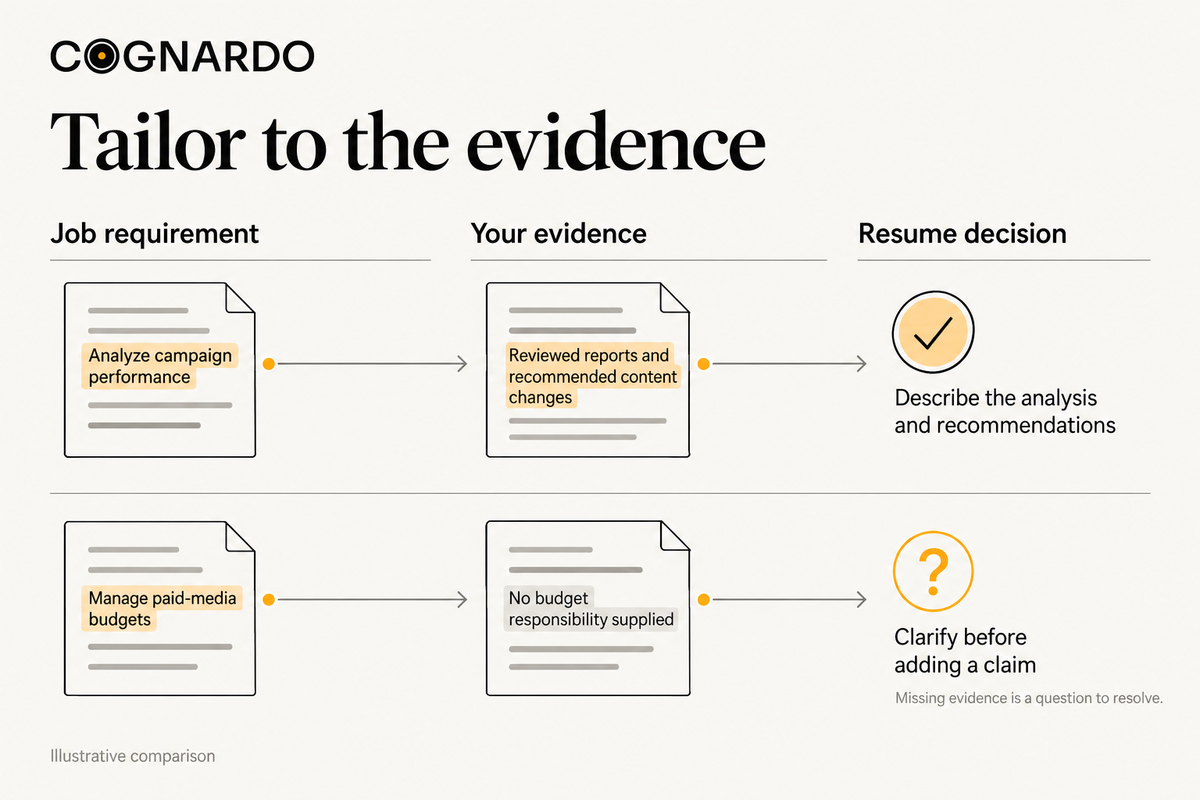
This is an illustrative comparison, not a completed candidate assessment.
Prompt 13: Build a Relevant, Evidence-Based Skills Section

Create a skills section for this application.

Job description:
{{job_description}}

Verified skills and examples of using them:
{{career_facts}}

Select relevant skills supported by my information. Group them only where grouping improves readability.

Use the employer's terminology when it accurately describes my experience. Do not infer tools, certifications, or proficiency.

Provide the skills section, then a separate evidence note for each inclusion. Flag uncertain matches for my review.
Keep truthful terminology; remove keyword lists that repeat the posting without demonstrating your capabilities.
Tailor the Content and Review the Changes
Prioritization and rewriting solve different problems. If your strongest experience is buried, change its prominence first. Rewrite only where the wording still leaves the relevance unclear.
Prompt 14: Prioritize Experience for One Target Role

Recommend how to prioritize this resume for the target job.

Resume:
{{resume_draft}}

Job description:
{{job_description}}

Identify which sections and bullets deserve more prominence, which need less space, and which may be omitted.

Explain each recommendation using a job requirement and existing resume evidence. Preserve reverse chronology within employment sections. Do not rewrite the resume yet or invent experience.
Review suggested omissions carefully. An older project may provide evidence that your current role does not.
Prompt 15: Tailor Selected Sections and Show the Changes

Tailor the selected resume sections to this job.

Resume:
{{resume_draft}}

Verified career information:
{{career_facts}}

Job description:
{{job_description}}

Sections to revise:
{{sections_to_revise}}

Improve relevance and clarity using supported facts only. Preserve titles, dates, qualifications, ownership, and metrics.

Return the revised sections followed by a change log showing original wording, revised wording, and the reason for each substantive change. Flag unresolved gaps rather than filling them.
Check the change log for stronger claims introduced through apparently minor wording edits.
Adapt Your Resume for Different Applications
Two roles with similar titles may emphasize different work. Comparing their requirements helps you decide whether you need substantially different versions or a few targeted edits.
Prompt 16: Compare Two Application Versions

Identify how my resume should differ for these two roles.

Base resume and verified supporting notes:
{{career_facts}}

Job description A:
{{job_description_a}}

Job description B:
{{job_description_b}}

Separate shared priorities from role-specific requirements. Recommend differences in emphasis, bullet selection, and skills, citing evidence from my background.

Keep factual history consistent. Flag evidence gaps separately for each role. Do not rewrite two complete resumes.
Check that the versions differ in emphasis without contradicting each other.
Check Formatting Before You Submit
An applicant tracking system, or ATS, may extract resume information into application fields. Greenhouse’s resume-parsing guidance identifies columns, complex tables, image-based resumes, and contact details inside headers or text boxes as potential problems.
ChatGPT’s review is not an actual employer ATS test or a guaranteed screening score. Pasted text also cannot establish how the original file is formatted.
Prompt 17: Review Visible Formatting and Parsing Risks

Review the supplied resume material for readability and common parsing risks.

Resume text, file, or screenshots:
{{resume_material}}

Employer submission instructions:
{{submission_instructions}}

Assess only what you can inspect. Check section labels, reading order, date consistency, and contact-information placement. Assess columns, tables, text boxes, or image-only content only when visible in the supplied material.

Separate observed issues from items you cannot assess. Recommend specific fixes without changing career facts. Do not claim to simulate the employer's ATS.
Follow the employer’s file instructions, inspect the final document, and correct any information the application form autofills incorrectly.
Keep the job description, selected bullets, and editing notes together in a Cognardo Workbench scratchpad. Name it after the company and role, and make it active before saving responses. See how Workbench scratchpads organize your drafts.
ChatGPT Prompts for Senior Roles and Complex Career Histories
Some resumes need more explanation than a list of positions can provide. A senior applicant may need to establish decision-making authority. A freelancer may have several clients in the same period. Someone returning to work may want to acknowledge a gap without discussing private circumstances.
Use these prompts to make that context understandable while keeping control over what you disclose.
Present Leadership Scope and Strategic Contributions
“Led strategy” leaves the reader guessing about your authority. Specify the decisions you made, the resources you controlled, and the outcomes connected to those decisions.
Prompt 18: Describe Leadership Responsibility and Outcomes

Develop resume bullets for {{target_role}} from the verified leadership notes below.

Leadership notes:
{{career_facts}}

Distinguish decisions I owned, recommendations I made, and work I executed. Include team size, budget authority, business scope, and outcomes only where supplied.

Separate direct reports from people I coordinated or influenced. Explain strategic contributions through specific decisions and their supported consequences.

Ask about unclear authority or attribution before drafting. Do not inflate seniority or imply ownership of company-wide results.
Check that coordinating colleagues has not become managing direct reports.
Organize Freelance and Contract Experience
Overlapping engagements can be legitimate parts of a freelance career. Make the relationship and dates clear so the reader can follow the work.
Prompt 19: Organize Multiple Engagements

Organize this freelance and contract history for {{target_role}}.

Engagements, dates, responsibilities, and disclosure restrictions:
{{engagement_details}}

Recommend either grouped freelance experience or separate engagement entries, explaining the choice.

Preserve dates and distinguish my business, contracting agency, and end client where relevant. Label concurrent work clearly. Use client names only where permitted.

Highlight relevant deliverables without presenting clients as employers or adding overlapping periods together as extra years of experience.
Confirm that the presentation accurately describes each working relationship.
Explain an Employment Gap Without Inventing a Story
A gap does not require a detailed personal account. CareerOneStop’s guidance on employment gaps notes that the reason need not appear on the resume itself. If you choose to include an explanation, keep it truthful and proportionate.
Prompt 20: Describe a Gap Using Only Information I Approve

Help me decide whether a brief gap entry would clarify this resume.

Resume:
{{resume_draft}}

Gap dates and explanation I am comfortable sharing:
{{approved_gap_details}}

Recommend whether an entry adds useful context. If it does, draft one neutral line using only my approved information.

Do not invent consulting, study, caregiving, or other activities. Do not request private details or extend employment dates. If no explanation is supplied, do not create one.
Keep only wording you are comfortable discussing further.
Present International and Remote Experience for US Roles
Clarify where you worked and whom you supported. Serving US clients remotely does not establish that you were based in the United States.
Prompt 21: Clarify International and Remote Work Context

Make this experience understandable for a US-targeted resume.

Verified career and education information:
{{career_facts}}

Target role:
{{target_role}}

Clarify employer context, actual work location, remote arrangements, and markets served where relevant and supplied. Expand unfamiliar abbreviations without changing official titles.

Preserve credential names. Do not invent US degree equivalence, GPA conversions, relocation plans, location, or work authorization. Flag anything requiring confirmation before inclusion.
Review location and qualification wording especially closely.
ChatGPT Prompts to Proofread and Fact-Check Your Resume
Review the tailored version you intend to submit. Earlier checks cannot catch a mistake introduced during the latest rewrite. These prompts separate language editing, relevance decisions, and factual comparison so each pass has a clear purpose.
Correct Grammar, Tense, and Inconsistencies
Prompt 22: Check Language and Consistency

Proofread this resume for a US application.

Resume:
{{resume_draft}}

Correct grammar, spelling, punctuation, and inconsistent formatting. Use present tense for ongoing responsibilities and past tense for completed work.

Standardize how dates are displayed without changing them. Flag conflicting dates, titles, or terminology instead of guessing the correct version.

Return the edited text and a short list of unresolved issues.
Check flagged inconsistencies against your records.
Remove Generic AI Phrasing
Review vague wording for usefulness. How a sentence sounds does not establish whether it was AI-generated.
Prompt 23: Replace Unsupported Generalities

Review this resume for generic or inflated wording.

Resume:
{{resume_draft}}

Verified source notes:
{{career_facts}}

Identify phrases that add little information or overstate the evidence. Replace them with supported specifics where available; otherwise recommend removing them.

Show original wording, revision, and supporting detail. Preserve meaning and do not invent achievements to make the language more distinctive.
Keep revisions that tell the reader something concrete.
Shorten the Draft Without Losing Important Evidence
Prompt 24: Recommend Cuts Based on Relevance

Recommend cuts to this resume for the target job.

Resume:
{{resume_draft}}

Job description:
{{job_description}}

Prioritize removing repetition, outdated detail, and material with little relevance. Protect required qualifications, distinct achievements, and context needed to understand them.

Show each proposed cut and its reason. Distinguish deletion from condensation. Ask before resolving uncertain trade-offs.
Approve the cuts before requesting a shortened version.
Compare Every Claim with Your Source Notes
Prompt 25: Audit the Draft Against Its Evidence

Compare this resume with my verified source notes.

Resume:
{{resume_draft}}

Source notes:
{{career_facts}}

Audit titles, dates, credentials, tools, metrics, ownership, and outcome claims. For each, identify the supporting note or mark it unsupported, contradicted, or requiring clarification.

Suggest a correction or question for flagged claims. Missing evidence is not proof that a claim is false. Do not treat this comparison as independent verification.
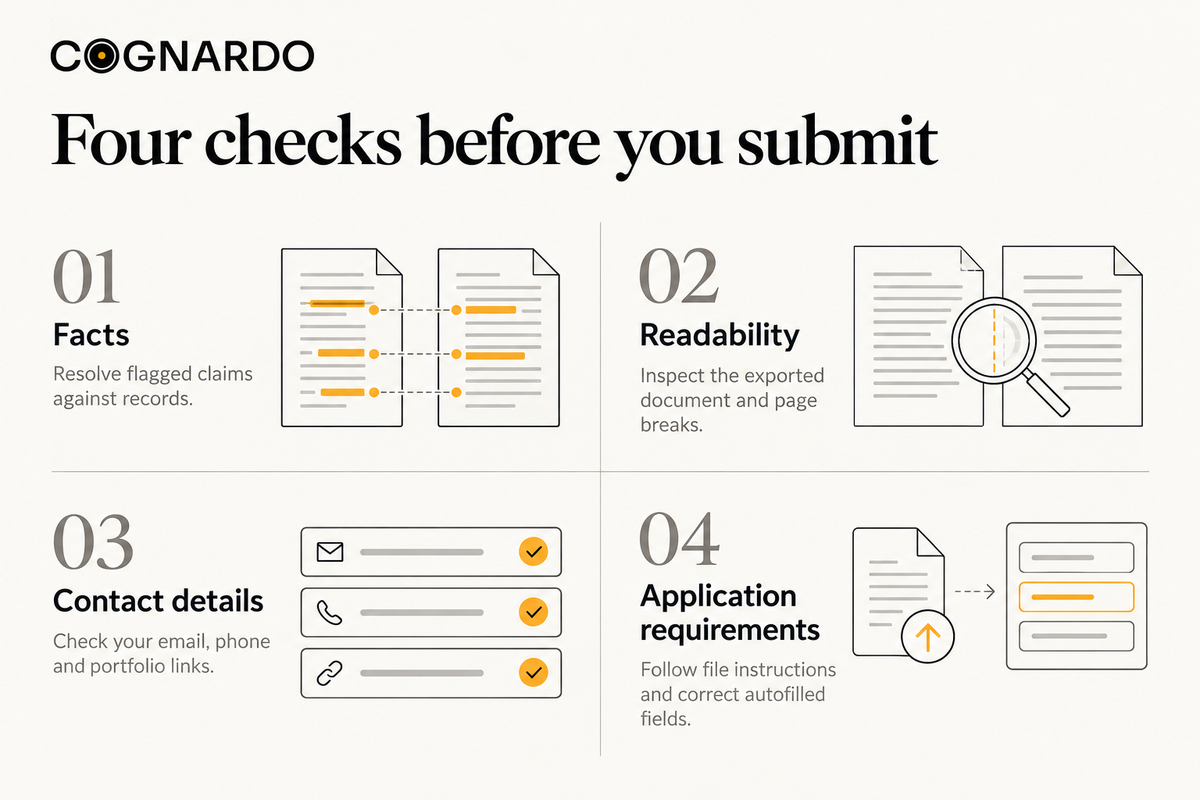
Before submitting, complete four checks:
- Facts: Resolve flagged claims against original records.
- Readability: Inspect the exported document, including page breaks.
- Contact details: Confirm your email, phone number, and portfolio links.
- Application requirements: Check requested files and correct any autofilled fields.
A Worked Example: From Career Notes to a Tailored Resume Section
The following candidate and job description are fictional. This is an editorial demonstration of how to apply the prompts, not a documented ChatGPT test or hiring result.
The Candidate’s Facts and Target Job
Leah has two years of experience as a marketing coordinator at a B2B software company. Her verified notes establish that she:
- Built and scheduled four customer newsletters each month in HubSpot.
- Coordinated registration and reminder emails for six webinars in the past year.
- Reported email open and click rates to the marketing manager.
- Had no paid-advertising responsibilities or verified revenue-attribution data.
The fictional marketing specialist opening asks for HubSpot experience, email execution, webinar coordination, and performance reporting. Paid-media experience is preferred.
Applying Prompt 12 identifies four supported matches and one evidence gap. The draft should emphasize the matches while leaving paid advertising out.
The Revised Bullet and Summary
Original bullet: Helped with email marketing and webinars.
Revised bullet:
Built and scheduled four customer newsletters monthly in HubSpot and reported email open and click rates to the marketing manager.
Summary:
Marketing coordinator with two years of B2B software experience in HubSpot email execution, webinar coordination, and performance reporting. Built and scheduled customer newsletters, coordinated registration and reminder emails for six webinars, and reported email engagement to the marketing manager.
The bullet applies Prompt 8’s action-and-scope approach. The summary uses Prompt 5 to bring relevant evidence together without repeating every responsibility.
What Improved and What Still Needs Checking
The revision makes Leah’s tool use, workload, and reporting responsibility visible. It provides evidence for the role’s requirements without upgrading her into a campaign strategist.
An addition such as “increased qualified leads by 30%” must be excluded because the source notes contain no supporting measurement. Prompt 25 should flag it for review.
Leah’s final check is to confirm the newsletter frequency, webinar count, reporting responsibility, and experience duration against her records. Every statement should remain accurate when discussed in an interview.
Build a Resume You Feel Confident Discussing
You do not have to account for your entire career in one application. Give the employer a clear picture of the experience that matters for this role, with details you can explain and stand behind.
Use these ChatGPT resume prompts wherever you need help, then make the final decisions yourself. The finished resume should feel familiar when you read it: your work, your contribution, and language you would be comfortable using in an interview.
Keep that preparation for your next application. Save Prompts 12, 15, and 25 as a sequence in Cognardo Workbench to match requirements, tailor your draft, and review its claims. You can return to a process you have already worked through, with each step ready for fresh context.
Frequently Asked Questions
Everything you need to know about the concepts discussed in this article.
Yes. You can paste these prompts, your career notes, and the job description into a regular text chat. You do not need a paid subscription to use them. File uploads are optional and have separate usage limits, as explained in OpenAI’s Free Tier FAQ. Pasting text works for content editing; reviewing the document’s visual formatting requires the relevant file or screenshots.
Review your account settings and share only what the task requires. For personal accounts, you can turn off Improve the model for everyone under Settings → Data controls. This prevents new conversations from being used for training, but does not delete them. Conversations submitted through feedback may still be used, as OpenAI’s data-control guidance explains. Temporary Chat stays out of history and is not used for model improvement while it remains temporary. OpenAI may retain a copy for up to 30 days for safety. These controls do not replace removing unnecessary personal or confidential information.
An AI-detector score is not conclusive evidence of authorship. OpenAI’s guidance on detection describes reliability problems, including human-written text being incorrectly flagged. An employer can still question vague claims, inconsistent experience, or wording you cannot explain. Focus on accuracy, specific evidence, and following application instructions.
Follow any explicit disclosure requirements or restrictions in the application. Check whether the instructions distinguish resume editing from assessments or writing samples. If asked, describe your actual use honestly, including what ChatGPT helped with and what you reviewed yourself. Do not claim you used it only for proofreading if it also drafted substantial sections.

Raven Black
AuthorI'm Raven Black, a content strategist with a background in sales, marketing, and an MBA in IT. I simplify complex ideas into engaging, human-first content. From fintech to SaaS, I craft SEO strategies that connect. Off work, I mentor writers and brainstorm ideas that make content truly matter.
View more from Raven Black
Cognardo Workbench
A new era of prompting. Our flagship tool is designed to help you interact with large language models more effectively.
Practical systems for better AI-era work.
Get our latest guides, tools, and research delivered directly to your inbox. No fluff, just practical systems for creators and professionals.
Privacy guaranteed. Unsubscribe anytime.