AI competitor analysis workbook
Turn a competitive question into an evidence-backed comparison and a decision — using AI for the heavy lifting, not for the facts.
This free workbook takes you from the decision you need to make, through sourced and verified evidence, to consistent competitor profiles, a side-by-side matrix, and an action plan.
10 structured worksheets · 12 comparison dimensions · 5 AI prompts
The problem
Most competitor analysis never reaches a decision.
It starts with a list, collects whatever is easy to find, and ends in a summary. AI makes that faster, and also makes it easier to fill the gaps with confident facts that are out of date or were never true.
A list of twenty competitors and no question
Competitor marketing copied in as fact
Current pricing “remembered” by an AI model
Every gap treated as an opportunity
A slide deck at the end instead of a decision
Definition
What is an evidence-backed competitor analysis?
A comparison of a focused set of competitors, on the same dimensions, where every important finding has a source — and the whole thing is built to support one specific decision.
Evidence, interpretation and hypothesis are kept apart, so you can see which conclusions rest on what.
The rules
Seven rules the workbook is built on.
- 01
Start with the decision, not with a long list of competitors.
- 02
Treat evidence, interpretation and hypothesis as different things.
- 03
Record where important findings came from. Do not rely on AI memory for current competitor facts.
- 04
Treat competitor marketing claims as claims unless independently supported.
- 05
A gap in competitor activity is not automatically a market opportunity.
- 06
AI can structure, extract, synthesise and challenge. You decide relevance and verify important claims.
- 07
Finish with a decision, an action, an experiment, or a clearly stated need for more research.
The important part
Not every finding is a fact.
Every row in the Evidence Log records where the finding came from, what kind of finding it is, how current it is, and whether anyone has checked it.
Profiles count only verified evidence, so it is obvious which competitor you actually know about and which one you are guessing at.
Verification
Freshness
Four classes of evidence
Direct Evidence
You can see it yourself: a price on a pricing page, a feature in the product.
Competitor Claim
What they say about themselves. Recorded as a claim until something supports it.
Observation
Something you noticed, like how they acquire customers. Useful, and still yours.
Unknown
You could not establish it. Written down, so nobody fills it in from memory.
How to run it
From question to decision in eight steps.
Each step has a clear “complete when” condition on the Start Here sheet, so you always know what is finished and what is still assumed.
- 01
Define the objective
The decision this research should support, the business, the customer, the market and up to three key questions.
- 02
Select competitors
Shortlist candidates, then deliberately choose a focused set of three to six for the main comparison.
- 03
Capture evidence
Log each important finding with its source, URL, type, access date and how current it is.
- 04
Verify key findings
Check the evidence your decision actually depends on, and mark it Verified or Needs Follow-up.
- 05
Build profiles
One standardised profile per competitor, drawn from reviewed evidence, with its uncertainties left visible.
- 06
Compare consistently
The matrix lines competitors up on the same dimensions, filled in automatically from the profiles.
- 07
Validate insights
Record why each observation matters, challenge it, and mark only the supported ones Validated or Prioritized.
- 08
Decide next actions
A decision-ready brief and an action plan, with owners, dates and the signal that will show it worked.
Who to compare
Three to six competitors, chosen on purpose.
Shortlist up to twenty, then pick the few with real market and customer overlap. Look beyond the obvious rivals: what customers do instead is often the competitor that matters most.
Twelve dimensions, the same for everyone.
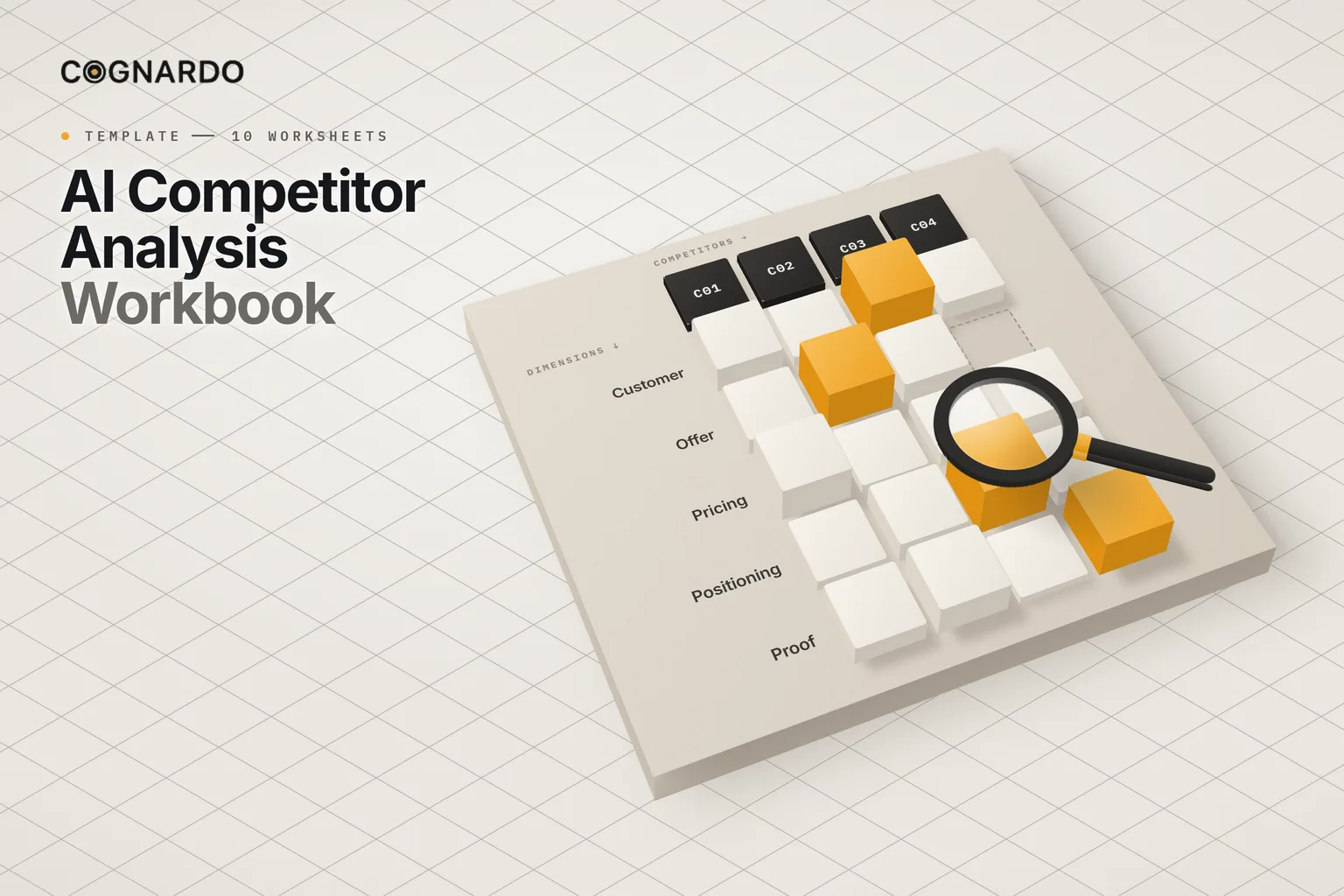
Switch any of them off, add up to three of your own, and the Comparison Matrix lines up to six competitors side by side automatically.
Customer
Target customer
Offer
Core offer
Problem
Primary problem addressed
Positioning
Value proposition / positioning
Pricing
Pricing / pricing model
Differentiation
Claimed differentiators
Growth
Marketing / acquisition observed
Proof
Trust / proof signals
Experience
Buying / customer experience
Strengths
Evidence-backed strengths
Gaps
Evidence-backed limitations / gaps
Uncertainty
Key uncertainties
From comparison to decision
A gap isn’t automatically an opportunity.
Nobody doing something can mean nobody noticed the need, or that the need isn’t worth serving. Each insight records why it matters to you, how confident you are, and whether it needs more research before anyone acts on it.
- 1Top competitive findings
- 2Important similarities
- 3Meaningful differences
- 4Potential gaps and opportunities
- 5Key risks
- 6Current uncertainties
- 7Decisions made
Followed by an action plan: each action or experiment tied to the insights behind it, with an owner, a date and a success signal.
The workbook
Research competitors once. Know what you actually know.
Everything above is on this page for free. The workbook does the part a webpage can’t: hold the evidence, count what is verified, and carry it through to profiles, a comparison and a decision.
ai-competitor-analysis-workbook.xlsx
XLSX · 10 worksheets
Enter your email and we’ll send the workbook straight to your inbox. Free, no account, no card.
We may email you occasionally for feedback, or to tell you about new Cognardo resources. Unsubscribe any time.
Built-in AI prompts
Five prompts, each for one stage.
Paste the relevant part of the workbook and your sources into ChatGPT, Claude or Gemini. The prompts work from what you give them, and you verify anything a decision depends on.
Research Planner
After Analysis Setup. Turns the decision and scope into a focused evidence plan.
Evidence Extractor
When you have source material. Proposes Evidence Log rows using only that source.
Competitor Profile Synthesizer
After evidence is reviewed. Drafts a standard profile without hiding uncertainty.
Cross-Competitor Analyzer
Once the profiles and matrix are mostly complete. Proposes patterns and hypotheses.
Conclusion Challenger
Before the Decision Brief. Stress-tests your conclusions instead of summarising them.
Where it helps
Any decision that depends on the competition.
Positioning a new offer
See how comparable offers are framed before you decide how yours should be.
Pricing decisions
Compare pricing models on evidence that is current, not remembered.
Before a launch
Know who you will be compared with, and on what, before customers do it for you.
Client and agency work
Deliver a competitive review with sources a client can check.
Fundraising and planning
Back the competition slide with evidence, uncertainties included.
Quarterly reviews
Re-run the same dimensions to see what has actually changed.
Keep it where you work
Keep the five prompts one click away.
Competitor research means running the same extraction and challenge prompts on source after source. Workbench is our browser extension for exactly that — keep prompts organised, fill the variables in a form, and run them without leaving ChatGPT, Claude or Gemini.
FAQ
Questions, answered.
What is a competitor analysis template?+
A structured way to research competitors against a specific decision: who to include, what to compare, where each finding came from, and what it means for you. This one runs from the objective through evidence, profiles and a comparison matrix to a decision brief and an action plan.
Can I use ChatGPT or Claude for competitor analysis?+
Yes, for the right parts. AI is good at planning the research, extracting findings from sources you give it, drafting profiles and challenging your conclusions. It is not a reliable source of current competitor facts. Prices, features and positioning change, so record where each important finding came from and verify it yourself.
How many competitors should I analyse?+
Usually three to six for the main comparison. Shortlist more if you need to, then choose deliberately based on market and customer overlap. A focused set you can research properly beats a long list you can only skim.
What is the difference between direct, indirect and substitute competitors?+
Direct competitors sell a comparable offer to the same customer. Indirect competitors solve the same problem in a different way. Substitutes are what customers do instead, which includes building it themselves or doing nothing at all.
Is a gap in the market an opportunity?+
Not automatically. A gap can mean nobody has noticed the need, or that the need is not worth serving. The workbook records each gap as an observation, asks why it matters to your business and how confident you are, and flags when more research is needed before treating it as an opportunity.
What should competitor research end with?+
A decision, an action, an experiment, or a clearly stated need for more research. If the analysis ends in a summary nobody acts on, it was not connected to a decision in the first place.
How often should I update a competitor analysis?+
Whenever the decision it supports comes up again, and at least before major launches or pricing changes. Because every finding carries an access date and a freshness status, it is easy to see which parts have gone stale.