AI competitor research workflow: from question to a traceable handoff
A practical 8-stage workflow for researching competitors with AI assistance — define the decision, gather evidence you can trace back to a source, verify what matters, and hand off findings with their caveats intact.
- Works with ChatGPT, Claude, Gemini or any general-purpose AI tool
- Built for positioning, offers, pricing, messaging, proof points and recent changes
- Quick, standard or deep research, depending on what the decision needs
The idea
What is an AI competitor research workflow?
Ask an AI tool to “analyse my competitors” and you get a confident overview built partly on stale or invented facts, with no way to tell which parts came from where.
A research workflow keeps the source attached. Each observation is logged with where it came from, findings point back to the evidence behind them, and anything weak or conflicting stays visible until it’s resolved.
The chain that has to stay traceable
AI helps scope the research, suggest candidates, extract evidence from text you supply, synthesise and spot gaps. AI memory or generated text is never evidence on its own.
The workflow
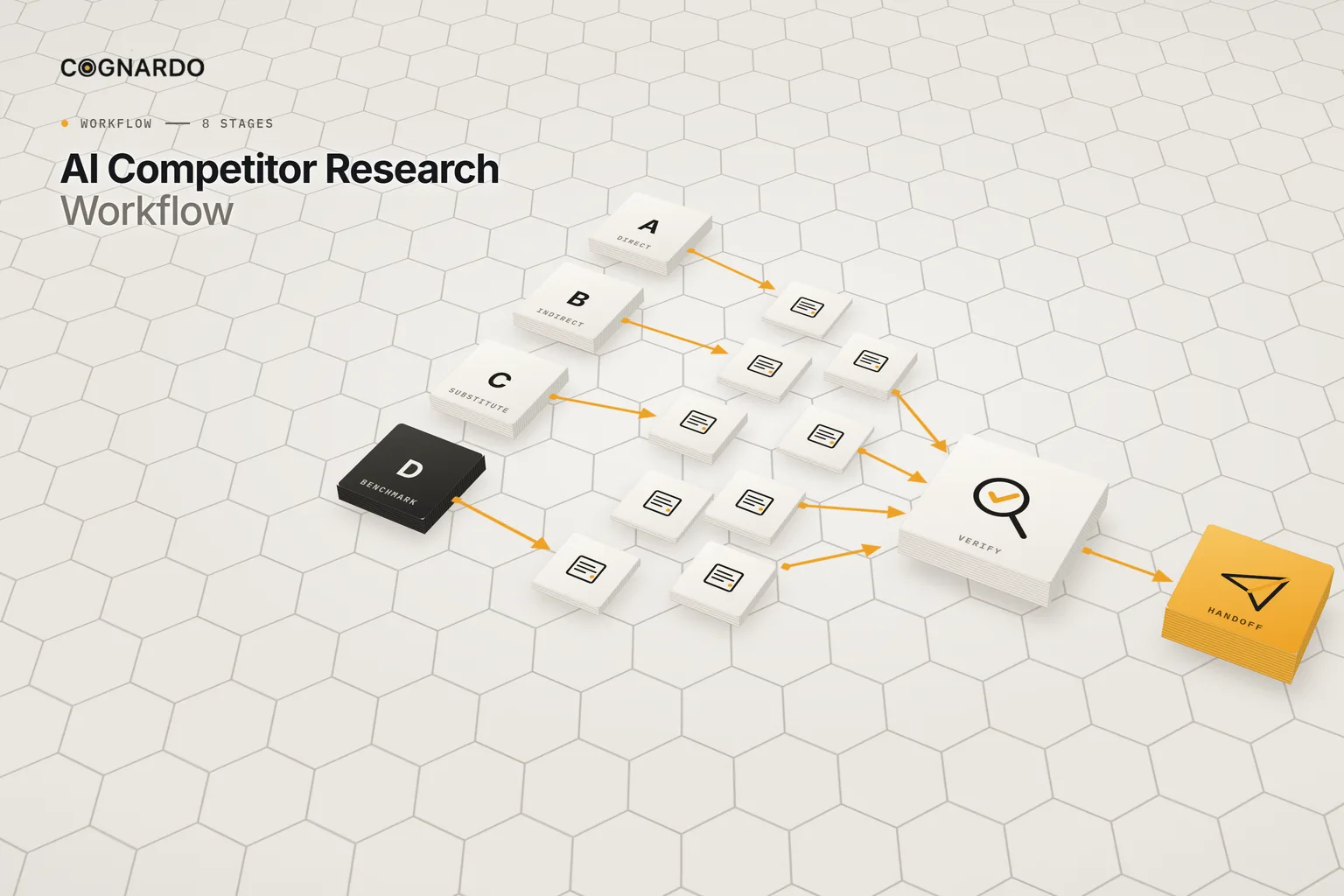
The 8-stage competitor research workflow.
Complete it in order the first time. During active research you’ll move back and forth between the evidence, the AI workspace, findings and verification.
- 01
Research brief
Define the decision, the market, the timeframe, how current evidence must be, the depth, and what makes the research sufficient. Then write the research questions.
Output: An approved research brief
Recorded in: Research Brief
- 02
Competitor set
Choose the competitors that genuinely help answer the questions — direct, indirect, substitute or benchmark — with an explicit reason for each.
Output: A bounded competitor set
Recorded in: Competitor Set
- 03
Research plan
Turn each question into an evidence-gathering task: what evidence, from which type of source, whether AI helps, and whether a manual check is needed.
Output: An investigation plan
Recorded in: Research Plan
- 04
Evidence log
One row per observation, with the source, URL, dates, evidence basis and whether it’s a source-backed observation or someone’s interpretation.
Output: A traceable evidence base
Recorded in: Evidence Log
- 05
AI workspace
Use AI only for defined tasks: refining scope, suggesting candidates, extracting evidence from supplied text, synthesising and spotting gaps.
Output: Reviewed working outputs
Recorded in: AI Research Workspace
- 06
Findings
Consolidate reviewed evidence into short competitor-level findings, each pointing to its Evidence IDs and keeping its caveat.
Output: Evidence-backed profiles
Recorded in: Competitor Findings
- 07
Verify & gaps
Resolve weak, outdated, conflicting or AI-inferred evidence. Anything still uncertain stays visible as a gap.
Output: Verified or openly unresolved status
Recorded in: Verification & Gaps
- 08
Handoff
Package the strongest findings, cross-competitor patterns, evidence strength and limitations, with a verdict: sufficient, sufficient with caveats, or not yet.
Output: A decision-ready research package
Recorded in: Research Handoff
Scope
Match the depth to the decision.
A quick look and a pricing decision don’t deserve the same effort. Choose up front, and write down what “sufficient” means.
Who to include
Four kinds of competitor.
Include one because it helps answer the question, not because it’s famous or easy to find. From the workbook’s examples:
Fictional Alpha Advisory
Same customer, comparable consulting offer.
Fictional Workflow Co.
Solves part of the problem through a different service model.
Fictional DIY Toolkit
The customer could buy a self-serve toolkit instead.
Fictional Category Leader
Useful for messaging or packaging, even at a larger scale.
The important part
Evidence, not impressions.
One row per observation, with enough source detail that someone else could check it. The workbook shows the difference:
Strong evidence
“Homepage states the flagship service is designed to help small teams shorten planning cycles.”
- Source
- Homepage · primary company source
- Type
- Source-backed observation
Not evidence
“AI says customers are highly satisfied.”
- Source
- AI-generated answer · no source
- Type
- AI interpretation
Interpretation type
Verification status
What sends it to verification
AI’s role
Eight prompts, one per defined task.
P1 · Research Brief
Refine the research scope
P2 · Competitor Set
Generate competitor candidates
P3 · Research Plan
Develop evidence-gathering tasks
P4 · Evidence Log
Extract structured evidence
P5 · Findings
Synthesize evidence into findings
P6 · Verification
Identify research gaps
P7 · Verification
Review contradictions and uncertainty
P8 · Handoff
Draft the research handoff
Ground rules
Six rules for competitor research you can trust.
Start with a decision
A research question tied to a decision stops broad collecting that never becomes useful.
Separate observation from interpretation
A sourced fact and a conclusion drawn from it are different things, and the log records which is which.
Preserve traceability
Every important finding should be checkable later, by you or someone else.
AI text isn’t evidence
AI can be wrong, stale or unsupported. A claim needs an appropriate source behind it.
Verify what matters most
Pricing, capabilities, positioning changes and strategic claims can move a decision. Check them.
Keep gaps visible
“Unknown” is more useful than false certainty. Unresolved items stay in the handoff.
In practice
One question, through the workflow.
Fictional example
How do direct competitors describe the primary outcome of their flagship offer?
- BriefObjective: understand how similar boutique service businesses position and package offers. Decision: how to differentiate a new consulting offer.
- PlanCapture exact wording from each direct competitor’s current offer or landing page — a primary company source, with a manual check.
- EvidenceStrong: the homepage says the flagship service helps small teams shorten planning cycles. Weak: “AI says customers are highly satisfied” — no source, not evidence.
- FindingPublic messaging emphasises speed-to-decision more than technical depth. Supported by two evidence records, with a caveat: public pages only.
- Verify“Pricing appears unchanged this year” is flagged as outdated evidence; the current pricing page needs checking.
- HandoffFindings go out with their Evidence IDs, confidence and caveats, plus a sufficiency verdict.
The kit
Put the workflow into practice.
Everything above is on this page for free. The kit solves the other problem: keeping the brief, competitors, evidence, findings and open questions linked as research moves back and forth.
ai-competitor-research-workflow.xlsx
XLSX · 9 sheets · 8 stages
Enter your email and we’ll send the workbook straight to your inbox. Free, no account, no card.
We may email you occasionally for feedback, or to tell you about new Cognardo resources. Unsubscribe any time.
Better together
Research, then decide.
This workflow is about gathering trustworthy evidence. Two companions turn it into comparison and a decision.
Compare
Profile and compare side by side
Standardised profiles, a comparison matrix on twelve dimensions, insights and a decision brief.
AI Competitor Analysis WorkbookDecide
Weigh the options
Turn what you learned into weighted criteria, recorded evidence and a documented decision.
AI-Assisted Decision Matrix WorkbookRun it where you research
Keep the eight research prompts ready.
Extraction, synthesis and gap-finding prompts get run on competitor after competitor. Workbench is our browser extension for exactly that — keep prompts organised, fill the variables in a form, and run them without leaving ChatGPT, Claude or Gemini.
FAQ
Questions, answered.
How do I do competitor research with AI?+
Use AI for defined tasks — scoping, suggesting candidates, extracting evidence from source text you provide, synthesising and finding gaps — and keep the evidence itself tied to real sources you can check. Don’t treat an AI overview as the research.
Can ChatGPT tell me what my competitors charge?+
Not reliably. Pricing changes, and a model may be out of date or simply wrong. Capture prices from a current first-party source, record the access date, and verify anything a decision depends on.
Which competitors should I include?+
The ones that help answer your research question. That can mean direct competitors, indirect ones, substitutes customers choose instead, and benchmarks worth learning from. Record why each is included.
What’s the difference between an observation and an interpretation?+
An observation is what a source shows, such as the wording on a pricing page. An interpretation is what you or AI conclude from it. The evidence log records which is which, so conclusions never pose as facts.
How is this different from the AI Competitor Analysis Workbook?+
This workflow focuses on gathering trustworthy, traceable evidence and verifying it. The analysis workbook goes further into standardised profiles, a comparison matrix, insights and a decision brief. They work well in sequence.
How much research is enough?+
It depends on the decision. Choose Quick, Standard or Deep up front and write success criteria. The handoff ends with an explicit verdict: sufficient, sufficient with caveats, or not yet sufficient.
What if sources disagree?+
Log both, flag the conflict in the verification queue, and record how it was resolved — or keep it as an open gap. A dedicated prompt helps you review contradictions without forcing a false answer.