AI content audit & refresh workflow: improve what you already have
A practical workflow for auditing existing content with AI support — decide what to keep, refresh, rewrite, consolidate or retire, refresh only what deserves it, and measure whether it worked.
- Works with ChatGPT, Claude, Gemini or any general-purpose AI tool
- Built for blogs, guides, landing pages, service pages, case studies and resources
- Performance data helps but isn’t required; “Unknown” is a valid answer
The idea
What is a content audit and refresh workflow?
Most refreshes start with “update this old post” and end with a new date on a page that’s been rewritten for no particular reason, or lightly polished when it needed much more.
An audit decides first. Every piece gets evidence, ratings and one of six actions. Only the pieces that deserve work get a brief, and AI only touches what the brief approves.
From library to result
AI can diagnose weak content, plan a refresh and revise approved sections. It must not invent analytics, sources, rankings or facts. The human confirms each decision, approves each brief and owns QA.
The workflow
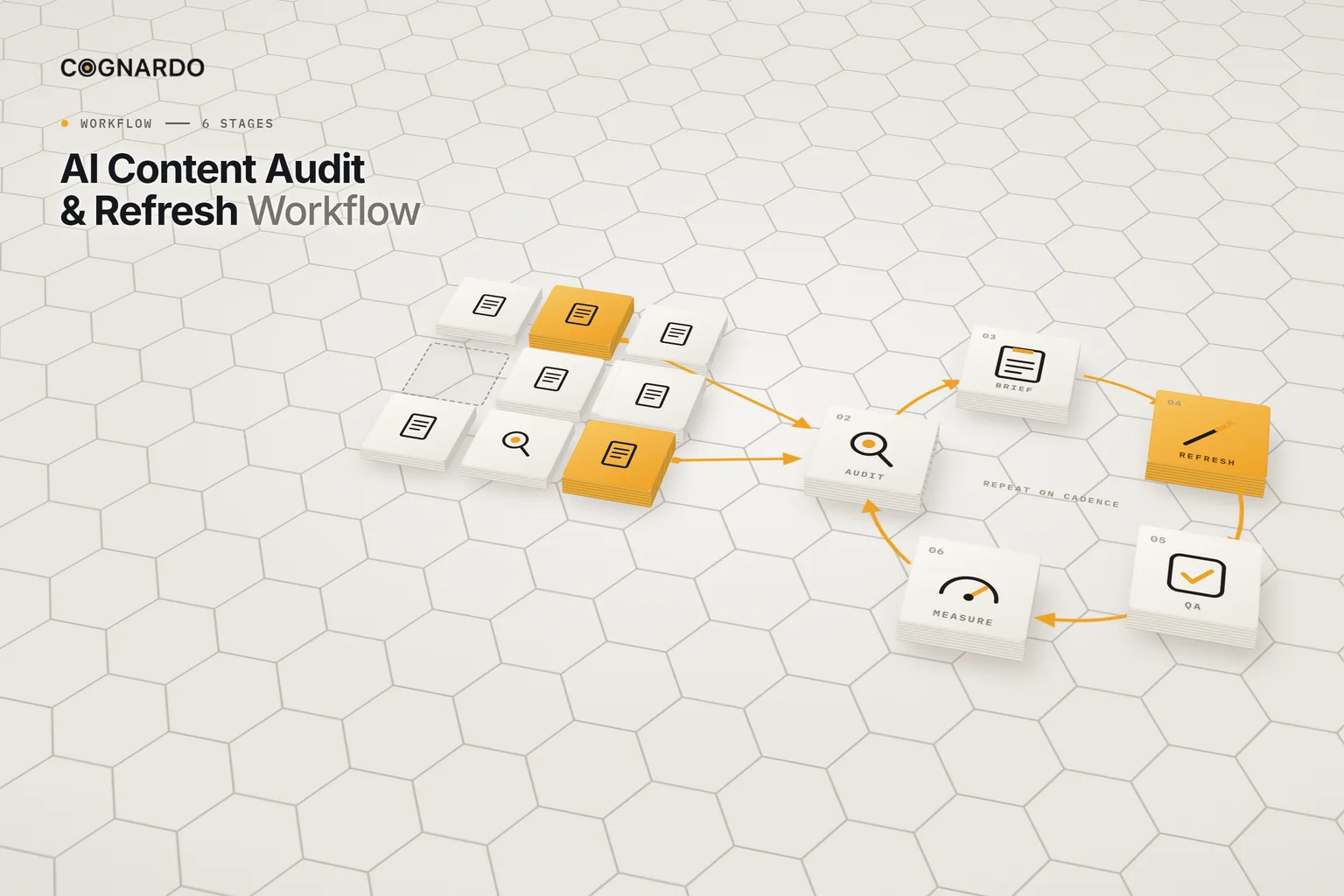
The AI content audit & refresh workflow.
It runs as a cycle: what you learn after publishing feeds the next audit.
- 01
Inventory
List the content in scope, one asset per row: purpose, audience, intent, CTA, dates, owner and whatever performance evidence exists.
Output: An audit-ready content list
Recorded in: Content Inventory
- 02
Audit & triage
Rate each asset on nine dimensions, note the evidence, and record a human decision from six actions. AI may recommend; you confirm.
Output: A decision for every asset
Recorded in: Audit & Triage
- 03
Prioritise & brief
For Refresh and Rewrite items, a transparent score sets priority. Then a brief records what must stay, what must change and how success is defined.
Output: An approved refresh brief
Recorded in: Refresh Queue & Brief
- 04
Refresh with AI
Use AI selectively — section refreshes by default, full rewrites only when that’s the decision — and log what was useful and what needs checking.
Output: A refreshed draft
Recorded in: AI Refresh Workflow
- 05
QA & publish
Check accuracy, completion, user value, consistency and publishing details, then record what changed and when it went live.
Output: A published, recorded update
Recorded in: QA & Publish
- 06
Measure
Compare a baseline with the result, note the qualitative outcome, decide the next action and set the next review date.
Output: A result, and the next review
Recorded in: Results & Cadence
The decision
Six actions. Refresh is only one of them.
Every audited piece ends with one explicit action. AI may recommend it; a person confirms it and writes down why.
Keep
Still accurate, useful and relevant. Record the decision and review again later.
Refresh
The useful core stays; specific facts, sections, examples or the CTA need work.
Rewrite
The topic matters but the execution is too weak or dated to repair section by section.
Consolidate
Several pieces overlap; one stronger page should absorb the useful material.
Retire / redirect
Obsolete, or it shouldn’t exist as a standalone page any more.
Investigate
Not enough reliable evidence to decide yet. Get it, then come back.
The audit
Nine ratings per piece.
Each scored 1–5, with direction marked so a 5 always means the same thing within a dimension.
Priority
A transparent score for what to do first.
For Refresh and Rewrite items only. It supports the decision; it doesn’t replace it.
20–25
High
14–19
Medium
5–13
Low
AI’s role
Five prompts, used selectively.
Each one runs only at its point in the workflow, and every important run is logged with what was useful and what still needs checking.
Content diagnosis
When an asset enters the audit. Finds weaknesses; never invents performance data.
Refresh plan
After a Refresh or Rewrite is approved and the brief is complete.
Section refresh
The default for refreshes: changes only the section with an approved change.
Full rewrite support
Only when the human decision is Rewrite, not for ordinary refreshes.
Refresh QA
After human editing, before the publication decision.
QA & publish · 18 checks
Separates “AI produced a draft” from “this is ready to publish”. Each category is Pass, Revise, Blocked or N/A.
Accuracy
- Facts and dates current
- Business details match reality
- Source-dependent claims checked
- Nothing invented during AI work
Refresh completion
- Every brief change addressed
- Outdated material removed
- Approved additions included
- Purpose and intent kept
User value
- Key questions answered
- Easy to scan
- Filler and generic AI wording removed
Consistency
- Tone and naming consistent
- CTA still correct
- Internal references still valid
Publishing
- Links checked
- Formatting and page fields intact
- Redirects recorded
- Update date is honest
Then measure
Improved · Stable · Declined · Too early
And decide whether it returns to the audit.
Ground rules
Four rules for audits that improve things.
Decide before you edit
Every piece gets an explicit action first. Refreshing isn’t the default; often the right answer is keep, merge or retire.
Low traffic isn’t low value
Performance evidence helps prioritise, but strategic value is rated separately. A small page can still matter.
Refresh sections, not everything
Change what the brief says needs changing. Full rewrites are their own decision, not a side effect of asking AI to “update” a post.
Dates must be honest
A new date reflects a real update. Changing the date without changing the content is checked for in QA.
In practice
One dated guide, start to finish.
Fictional example
“Small Business Email Marketing Guide”
- InventoryStill supports a relevant topic, but several recommendations and screenshots are outdated.
- AuditHigh strategic value, high freshness risk, a useful core and specific gaps — not a case for replacement.
- DecisionRefresh. The brief records what must stay, what must change and what must be verified.
- RefreshOutdated guidance replaced, missing explanation added, the CTA reviewed.
- QA & publishFacts checked, human QA passed, and the update date, major changes and next review date recorded.
- MeasureThe post-refresh result is compared with the baseline, and the next review is scheduled.
The kit
Put the workflow into practice.
Everything above is on this page for free. The kit solves the other problem: keeping the inventory, decisions, briefs, AI work, QA and results for a whole content library in one place.
ai-content-audit-refresh-workflow.xlsx
XLSX · 7 sheets · 100 assets
Enter your email and we’ll send the workbook straight to your inbox. Free, no account, no card.
We may email you occasionally for feedback, or to tell you about new Cognardo resources. Unsubscribe any time.
Better together
Decide, then optimise.
The audit tells you what to improve. Two companions go further on choosing new topics and on visibility in AI answers.
New topics
Find the next opportunities
Prioritise what to create or refresh using search, audience, competitor and AI-visibility signals.
SEO + GEO Content Opportunity WorkbookHigher stakes
Verify the refreshed claims
For refreshes that change facts, figures or recommendations, check them claim by claim.
AI Output Verification ChecklistRun it where you edit
Keep the refresh prompts ready for every page.
Diagnosis, section refresh and QA prompts get reused across the whole library. Workbench is our browser extension for exactly that — keep prompts organised, fill the variables in a form, and run them without leaving ChatGPT, Claude or Gemini.
FAQ
Questions, answered.
What is a content audit?+
A structured review of existing content to decide what each piece needs: nothing, a refresh, a rewrite, merging with another piece, retirement, or more investigation. It turns a vague “our blog is out of date” into a prioritised list of decisions.
How often should content be refreshed?+
There’s no universal schedule. Review on a cadence that matches how fast your topic changes, and refresh when an audit shows a specific reason: outdated facts, changed offers, weak sections or a mismatch with what readers now need.
What’s the difference between a refresh and a rewrite?+
A refresh keeps the useful core and fixes specific parts. A rewrite rebuilds the piece around a new brief because the existing execution can’t be repaired efficiently. The workbook treats them as separate decisions with separate prompts.
Can AI audit my content?+
It can diagnose likely weaknesses in content you give it. It can’t know your strategy, and it must not invent traffic, rankings or sources. The workflow uses AI for diagnosis and revision, and keeps decisions and verification with a person.
Do I need analytics data?+
No. Performance evidence makes prioritisation better, but every evidence field accepts “Unknown” or “Not Available”, and strategic value is rated separately. Qualitative outcomes count when numbers don’t exist.
Should I update the date after a refresh?+
Only if the content genuinely changed. QA includes a specific check that the update date reflects an actual update, not a cosmetic one.
When should I consolidate content?+
When two or more pieces substantially overlap and one stronger page should absorb what’s useful from the others. Record which page survives and how the others are handled, such as redirects.