AI social listening & lead discovery workflow: real needs, responsible replies
A practical 6-stage workflow for finding people publicly describing the problems you solve — capture the evidence, score and verify each signal, and engage only where it’s appropriate and approved.
- Built for freelancers, consultants and small businesses
- Manual and permission-first: no scraping, no automated outreach
- Treats a useful insight or a rejected lead as a valid result
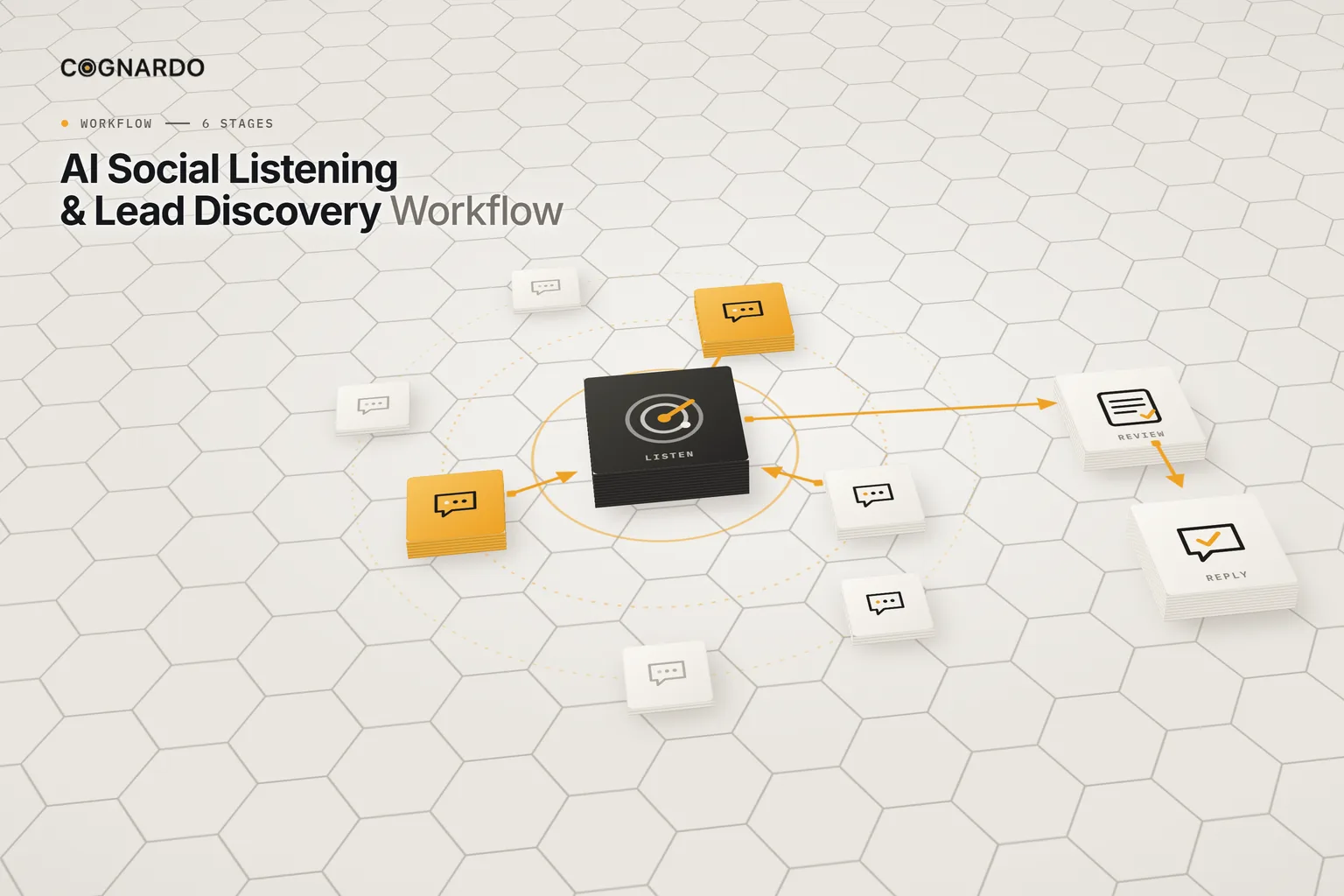
The idea
What is social listening for lead discovery?
Most “social selling” is either scrolling until something looks promising or blasting messages at anyone who mentioned a keyword. The first wastes time; the second annoys people and can break platform rules.
This workflow is narrower: a few focused searches, a record of each relevant conversation with its source, a simple score, and a deliberate human decision about whether — and how — to respond.
From conversation to outcome
AI helps build searches, triage signals, draft a value-first reply and summarise the week. It can’t establish permission, confirm a source or identify a buyer. People do that, and send every reply themselves.
The workflow
The 6-stage social listening & lead discovery workflow.
It runs weekly. Each cycle ends with changes to next week’s searches, based on what actually turned up.
- 01
Plan
Write a short brief: your offer, ideal audience, problems you solve, qualification indicators, exclusions and objective. Then set up three to five focused searches.
Output: A focused listening plan
Recorded in: LISTENING PLAN
- 02
Discover
Run the saved searches manually in sources you’re permitted to access. Ignore irrelevant results quickly.
Output: Potential signals
Recorded in: LISTENING PLAN
- 03
Capture
Log each relevant discussion once: the URL, publication date if known, the signal type and a factual summary of the need.
Output: Traceable signal records
Recorded in: SIGNAL REGISTER
- 04
Qualify
Check the original source and duplicates, then score audience, problem, intent and timing from 0 to 2. Unverified or duplicate signals are held.
Output: Human-checked priorities
Recorded in: SIGNAL REGISTER
- 05
Engage
Decide whether engagement is appropriate, choose a route, record the permission basis, get approval, then respond yourself.
Output: Only eligible, reviewed actions
Recorded in: SIGNAL REGISTER
- 06
Review
Look at the week’s scorecard, record what to continue, stop, change and test next, and update the searches.
Output: Next cycle’s changes
Recorded in: WEEKLY REVIEW
What to listen for
Six kinds of signal.
Not every relevant conversation is a lead. Classifying it first stops you treating frustration or curiosity as buying intent.
Scoring
Four scores, 0 to 2 each.
The important part
A high score never grants permission.
The action gate opens only when the source is verified, the URL is unique, a human has approved the review, and a permission or channel basis is documented.
Only review legitimately accessible material
Never automate scraping or bulk-harvest personal data
A public post isn’t permission to send a direct message
Mark a source Verified only after checking its original context
A high score never authorises outreach
Human approval and a documented basis before any reply or contact
Engagement route
Five ways to handle a signal.
AI’s role
Four task cards. AI never sends anything.
Listening query builder
After the listening plan: suggests focused searches you then test manually.
Signal triage assistant
With a short, non-sensitive summary and a link. You assign the final scores.
Value-first response assistant
Only after you’ve found an appropriate channel and documented permission.
Weekly insight synthesiser
After the weekly review, using aggregated, anonymised themes.
Ground rules
Four rules for listening without spamming.
Permission before contact
A public post is not an invitation to a DM. Every reply or contact needs a documented basis and human approval.
A score isn’t permission
Eight out of eight means the signal matters. It still has to pass the action gate before anyone acts on it.
Summarise only what the source says
The need summary is factual and minimal. AI summaries are suggestions, never proof.
Insight is a result too
A recurring need you can’t act on yet, or a lead you decided not to pursue, is useful information for the next cycle.
In practice
One conversation, handled properly.
Fictional walkthrough · not real lead data
A store publicly asks for recommendations for onboarding-email help this month
- CaptureLogged with its link and date as a “Direct provider search”, with a factual one-line summary of the need.
- QualifyAudience 2 + Problem 2 + Intent 2 + Timing 2 = 8/8, held until the original request is checked.
- VerifyThe original request is confirmed, and the URL isn’t a duplicate. Priority: High.
- EngageThe discussion’s rules allow helpful public replies. Route: public reply. A human approves it. Not a DM.
- OutcomeA permitted, helpful reply may lead to a two-way conversation. Whatever happens is recorded against the original signal.
The kit
Put the workflow into practice.
Everything above is on this page for free. The kit solves the other problem: keeping searches, signals, scores, permissions and outcomes in one place, week after week.
ai-social-listening-lead-discovery-workflow.xlsx
XLSX · 5 sheets · 6 stages
Enter your email and we’ll send the workbook straight to your inbox. Free, no account, no card.
We may email you occasionally for feedback, or to tell you about new Cognardo resources. Unsubscribe any time.
Better together
From signal to qualified lead.
Listening finds the conversations. These help with what happens when one turns into a real opportunity.
Next
Qualify the lead
A structured, AI-assisted way to judge fit and readiness once a conversation becomes a real enquiry.
AI-Assisted Lead Qualification WorkflowInsight
Turn needs into content
Recurring questions you hear are strong content opportunities, alongside search and AI-answer signals.
SEO + GEO Content Opportunity WorkbookRun it where you listen
Keep the four task cards one click away.
Query building, triage and value-first replies come round every week. Workbench is our browser extension for exactly that — keep prompts organised, fill the variables in a form, and run them without leaving ChatGPT, Claude or Gemini.
FAQ
Questions, answered.
What is social listening?+
Monitoring public conversations for mentions of the problems, needs and topics relevant to your business. For a small business, it’s less about brand monitoring at scale and more about noticing real people asking for help you can genuinely give.
Can I use social listening to find leads?+
Yes, carefully. Some conversations are people actively looking for a provider. Many more are useful insight rather than leads. The workflow scores each signal and keeps outreach behind a human approval and a documented permission basis.
Is it OK to DM people who post about a problem?+
Not by default. A public post isn’t permission for a direct message. Follow the platform’s rules and the discussion’s norms; often a helpful public reply, where invited, is the appropriate route.
Does this workflow automate monitoring?+
No. It’s deliberately manual: saved searches you run yourself in sources you’re permitted to access. It never scrapes, mines private groups or harvests personal data.
How do I score a signal?+
Rate audience fit, problem fit, intent and timing from 0 to 2. Six or more is High, four or five is Review. Priority is held until you’ve checked the original source and ruled out a duplicate.
How can AI help with social listening?+
Building focused search queries, triaging a signal you’ve summarised, drafting a value-first reply once engagement is approved, and summarising weekly themes. It can’t verify a source, establish permission or tell you who is really a buyer.
How much time does it take?+
Start with three to five searches and a weekly rhythm. The weekly review is where you drop noisy searches and keep the ones that surface real needs, so the cycle gets faster.